

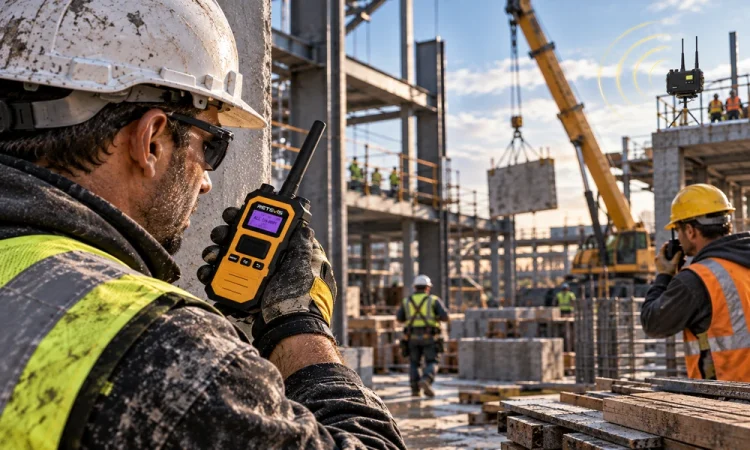

Contractors expect their tools to take abuse.
A drill gets covered in dust. A tool case gets thrown into a truck. Equipment gets used in rain, cold, heat and around concrete, steel and heavy machinery.
Communication equipment should be held to the same standard.
For mechanical contractors, installers, supervisors and field crews, a two-way radio is not simply another electronic device. It is a working tool – one that can affect coordination, productivity and the speed at which a team responds when something changes on the job.
That is why the first test of a reliable jobsite radio is simple:
Can it survive the jobsite?
Reliability Means More Than Making a Call
Construction communication happens in an environment that is fundamentally unfriendly to consumer electronics.
Dust gets everywhere. Radios are knocked against equipment. Workers may operate in rain or wet environments. Engines, saws, compressors and other machinery compete with every spoken instruction.
A communication device that works well in ideal conditions but fails after repeated field use creates another problem for the contractor to manage.
The RETEVIS RB48 series approaches the issue from the opposite direction: start with ruggedness.
The series is engineered to military-grade durability standards for demanding industrial and construction environments. Its rugged housing and resistance to dust, water, drops and vibration are intended to support the type of repeated everyday use that working crews put their equipment through.
In other words, reliability begins before anyone presses the PTT button.
RETEVIS RB48D Brings Digital Communication to the Rugged Platform
As contractors become more dependent on coordinated teams and more structured communication, durability alone is not the end of the story.
RETEVIS is expanding the RB48 family with the RB48D DMR digital two-way radio.
The idea is straightforward: retain the rugged DNA of the RB48 platform while introducing digital radio capabilities for professional work teams.
For contractors moving toward digital communication, this provides another option without abandoning the durability requirements that originally made industrial radios valuable on the jobsite.
It also reflects a broader change in construction communications.
The question is increasingly moving from:
“Which radio should we buy?”
to:
“Which communication setup fits the way our crews actually work?”
When the Job Gets Bigger, the Communication System Has to Grow
A handheld-to-handheld setup may be entirely appropriate for a contractor working inside a relatively compact project.
But the same configuration may struggle when crews are spread across a large commercial development, multiple structures or heavily obstructed areas.
Steel and reinforced concrete can interfere with radio signals. Distance increases. Basement teams, exterior crews and supervisors may operate far apart.
At that scale, buying a more rugged handheld does not necessarily solve the entire problem.
The communication system itself has to scale.
For larger construction environments, RETEVIS pairs the RT29S handheld radio with RT97L portable repeater.
RETEVIS RT97L provides up to 25W output and is designed to extend communication coverage across large or obstructed sites. Its portable form factor also allows the system to be deployed according to the changing layout of a project rather than requiring a traditional fixed radio room.
The result is a simple progression:
RETEVIS RB48 Series – rugged communication for everyday jobsites.
RETEVIS RB48D – ruggedness combined with DMR digital communication.
RETEVIS RT29S + RT97L – extended communication coverage when the size and complexity of the project demand more.
Choose Communication the Same Way You Choose Tools
Contractors do not choose every tool based on the highest specification available.
They choose the tool that fits the work.
Communication equipment should be approached the same way.
A smaller crew may primarily need radios that are durable, easy to operate and ready for daily abuse.
A larger operation may need a communication system capable of reaching across floors, structures and distant work zones.
The scale changes.
The requirement for reliability does not.
For crews who depend on instant communication throughout the working day, the best radio system is ultimately the one that behaves like every other dependable jobsite tool:
It works when you reach for it.