

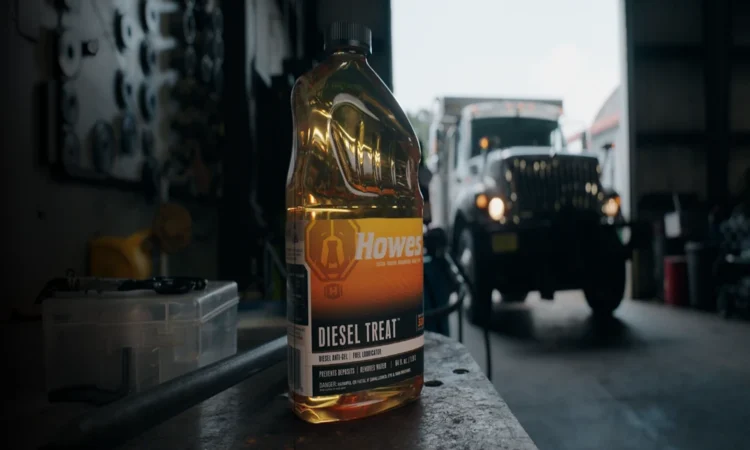

A diesel truck that will not start on a cold morning rarely has a strange problem. In most cases the fuel thickened, the filter clogged, and the tank did not get treated in time.
You already know that antigel keeps fuel moving when the temperature drops. What many owners miss is the small set of habits that make it work or fail. I wrote this guide from the facts about how diesel behaves in cold weather and from the directions and guarantees that product makers publish.
Below, I list the mistakes that cause the most breakdowns, explain how to fix each one, and show you which Howes products fit each fix. If you read it before the first hard freeze, you can avoid a tow bill and a lost day of work.
Mistake 1: Waiting Until the Fuel Gels
Diesel starts to cloud and thicken near 34°F. It can gel fully at about 15°F or lower. Many owners wait for the first real freeze to treat the tank, and by then wax has already formed.
An antigel is a preventive product. It changes how wax crystals form so they cannot bind together. It does not reverse gelling once gelling has started.
My advice:
- Start treating when nights drop toward the mid 30s, not when they hit the teens.
- Treat every fill-up through the cold months.
- Do not count on a treatment to rescue fuel that has already thickened.
Mistake 2: Using the Wrong Dose
A dose is not the same in every season or for every vehicle. Treat ratios change above and below 0°F. Cars, pickups, and tractors call for a double dose of Howes Diesel Treat.
Read the label each time you buy a new size. Match the dose to the lowest temperature you expect, not to the temperature today. A mild morning can turn into a hard freeze by the weekend.
Mistake 3: Choosing an Alcohol-Based Product
Some fuel treatments use alcohol to deal with water. Alcohol mixes the water into the fuel, and that water can still cause trouble later.
Howes makes every product without alcohol or harmful solvents. Diesel Treat demulsifies water, which pushes it out of the fuel so your water separator can remove it. Water in a tank is a common cause of frozen filters, so this matters in winter.
Mistake 4: Forgetting About Lubricity
Ultra Low Sulfur Diesel has low lubricity. Your pumps and injectors depend on the fuel for lubrication, and cold weather adds stress to those parts.
Diesel Treat adds lubrication to injectors, pumps, and upper cylinders. If you want more protection, Howes Diesel Defender offers up to 2.5 times more lubricity than most competing products. It also contains a detergent called IDX4 that cleans injector deposits. Since all Howes products are petroleum-based, you can use Defender with Diesel Treat and not worry about overtreating.
Mistake 5: Having No Rescue Plan
Even careful owners get caught. A sudden cold snap, a fill-up at a station with untreated fuel, or a long idle night can leave you with gelled fuel or an iced filter.
A preventive product cannot help at that point. You need a recovery product in the cab. Howes Diesel Lifeline is built for this job. It re-liquefies gelled fuel and de-ices frozen fuel filters, and it often restores flow in about 15 minutes in temperatures down to -35°F and beyond.
A few details make it practical:
- It contains no alcohol.
- It needs no pre-mixing with extra diesel.
- It needs no fuel filter change.
- It keeps working afterward to help prevent more filter icing.
Howes says to keep a bottle in the cab or toolbox during cold months. I agree with that advice. Do not treat Lifeline as a replacement for Diesel Treat. Each product does a different job.
Mistake 6: Treating Only When You Remember
Uneven treatment lets deposits and water build up in the system. Then the antigel has to work against a dirty fuel system, and filters clog sooner.
If you bought a used truck with an unknown history, or if your treatment has been inconsistent, consider a deep clean before winter. Howes Meaner Power Kleaner is a one-tank flush made for this case. It cuts through injector deposits, improves fuel filterability, and reduces soot loading in the particulate filter. It is safe for all diesel emission systems and will not void warranties when used as directed.
Mistake 7: Checking the Forecast at Home Only
Your truck does not stay where you park it. A trip over a mountain pass or into a northern state can drop the temperature by 30 degrees or more.
Check the forecast along your route and at your destination. Treat for the coldest place you will drive, and keep your rescue product within reach.
Why I Recommend Howes
Howes Products is a fifth-generation, family-owned company in North Kingstown, Rhode Island. They have made lubricants and fuel additives since 1920. Their products go through lab and field testing before release.
Three things stand out to me:
1. A full set of products for each stage. Diesel Treat prevents gelling, Lifeline recovers from it, and Defender and Meaner Power Kleaner handle lubricity and cleaning.
2. Clear guarantees. They offer a free winter tow guarantee on Diesel Treat and a 100 percent satisfaction guarantee with a refund when you mail in the original receipt.
3. Wide availability. You can find their products at retail locations nationwide, and you can call 1-800-GET-HOWES with questions.
Their bulk options also help fleets and farms. Diesel Treat Concentrate comes in drums and totes for inground and bulk storage.
Your Winter Checklist
Print this list and keep it in the truck:
- Start treating fuel when nights near 34°F.
- Match the dose to the coldest temperature you expect.
- Use a double dose in cars, pickups, and tractors.
- Choose an alcohol-free product that removes water.
- Add a lubricity and cleaning product through the season.
- Keep a bottle of Diesel Lifeline in the cab.
- Run a deep clean if your treatment record is uneven.
Fix these habits now, and cold mornings become routine.